In the first two installments of this series, we traveled. We looked at Whistler, Peninsula Papagayo, Teton Village, and Hualālai — four global markets that have already completed the institutional transition now underway in Telluride. The thesis in each case was the same: the arrival of a global luxury anchor brand doesn't just add amenities. It re-rates the destination's price floor permanently, and the most efficient entry point for capital is always the anticipation phase — before the doors open, before the benchmark is operational, before the market has fully priced in what is coming.
Now we bring it home.
The most tangible, quantifiable expression of that thesis in the 2026 Telluride market is a number that every buyer who has spent an afternoon on a listing portal has already encountered. Based on our analysis of closed MLS transactions through Q1 2026, Mountain Village condominiums are trading at approximately $1,320 per square foot. In-town Telluride condominiums are trading at approximately $2,015 per square foot. On the single-family side, the figures are $1,510 per square foot in Mountain Village against $2,115 in Town.
That is a gap of roughly 35% in the condo segment and 28% in single-family. It has existed long enough that buyers have come to treat it as a permanent feature of the market. It is not. It is a temporary condition, and it is being structurally dismantled by exactly the forces this series has described.
The Gap Has Never Been About the Mountain
This is the most important framing correction in understanding the current opportunity.
Mountain Village and the Town of Telluride share the same terrain. They share the same lifts. They are connected by a free, 13-minute gondola that runs year-round. A buyer in Mountain Village is not buying a lesser ski experience — in many respects, ski-in/ski-out access in the Village is superior to anything available in Town. The mountain is not the variable that created the gap.
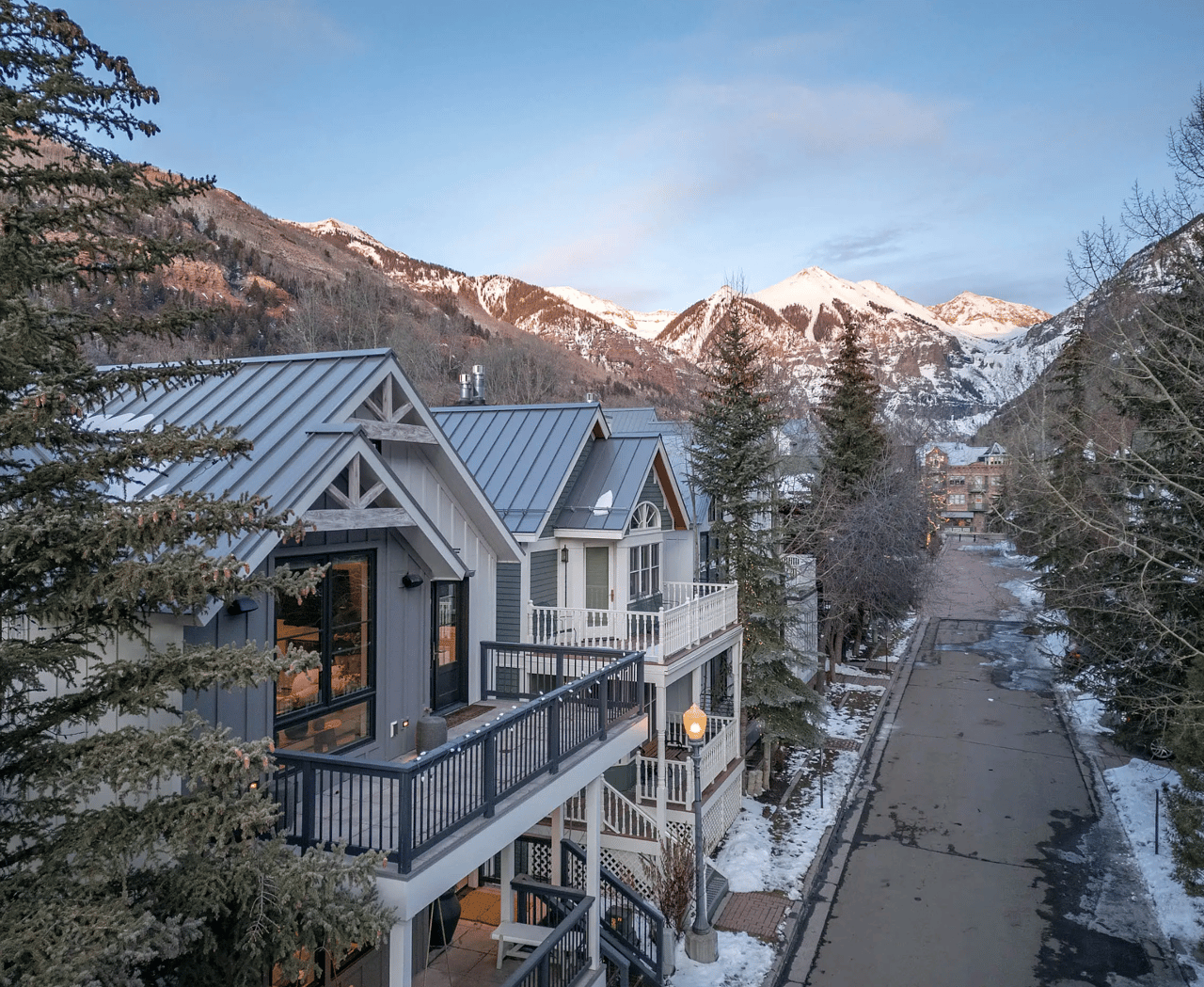
The variable was the amenity stack surrounding the mountain. In-town Telluride has carried its price premium for decades on the strength of its walkable historic core, its independent restaurant scene, its cultural institutions, and the kind of street-level lifestyle density that Mountain Village — as a planned resort community — has historically been unable to replicate. UHNW buyers were not paying $2,015 per square foot for Victorian facades. They were paying for a lifestyle environment that Mountain Village, until recently, could not fully match.
Three projects, delivering within a three-year window, are changing that math simultaneously.
The Three-Part Catalyst
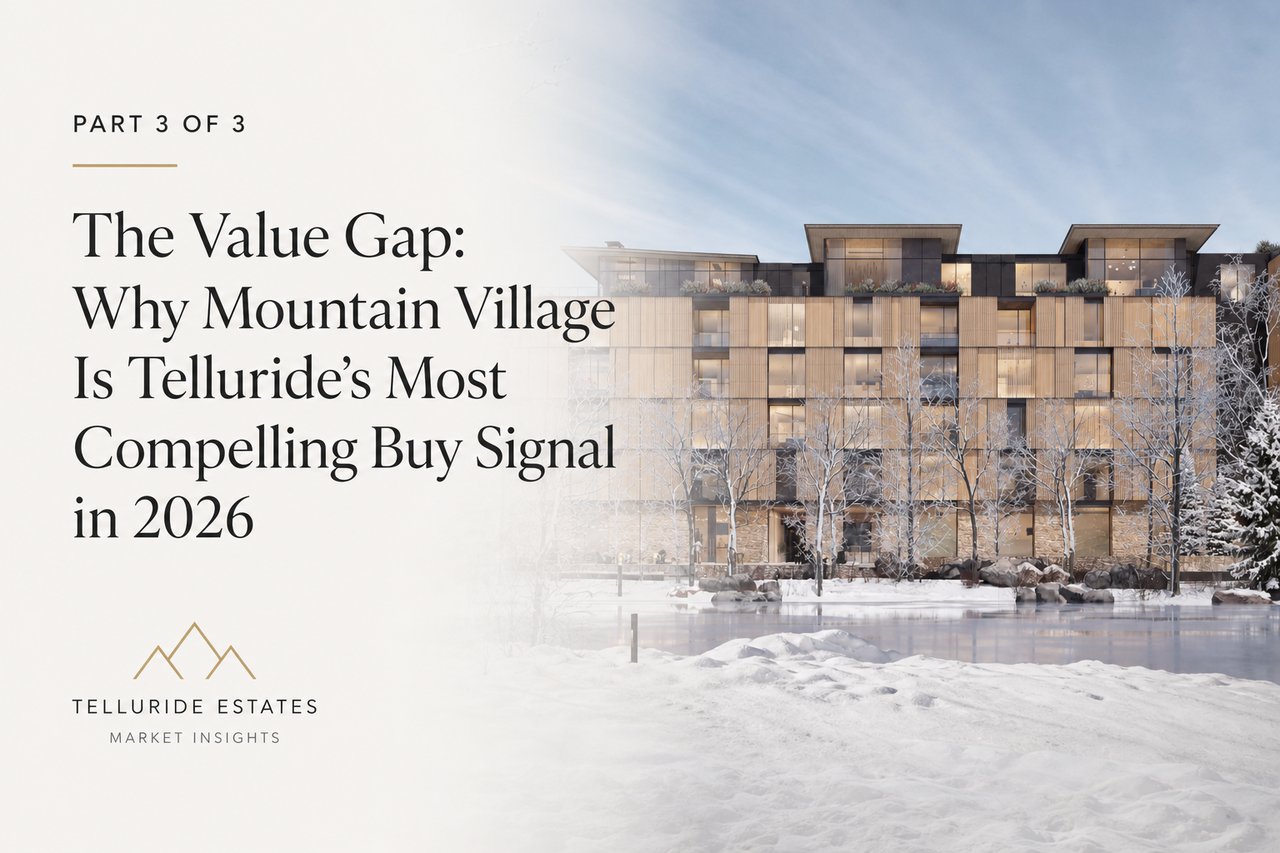
The Four Seasons Resort and Residences Telluride is the central argument. Announced in September 2025 by Fort Partners, Merrimac Ventures, and Four Seasons, it is Telluride's first five-star development in fifteen years. The project brings 52 guestrooms, 43 Hotel Residences, and 26 Private Residences to Mountain Village, with architecture by Olson Kundig and interiors by Clements Design. The program includes ski valet, private owner lockers, two culinary outlets, a spa with thermal lounge, cold plunge, and eight treatment rooms, a lap pool, and a dedicated Director of Residences whose sole function is ensuring that ownership at this address performs to Four Seasons standards globally.
That last point deserves emphasis. A Director of Residences is not an amenity — it is an infrastructure. It is the operational architecture that makes a Mountain Village address feel continuous with the owner's standard of living everywhere else they hold property. For the buyer managing multiple homes across multiple time zones, this changes the fundamental calculus on Village ownership.
The Alpine Club moves the lifestyle argument directly into the terrain. Developed by Southworth in partnership with Scott and Lauren Woodward, the 26,000-square-foot private on-mountain club at San Sophia Station — the gondola node connecting downtown Telluride to Mountain Village — is targeted for opening in the 2026/27 ski season. Its program includes a spa, sauna, steam room, cold plunge, stretch lab, chef's table, kids club, and a private après lounge. Southworth has also established partnerships with the Telluride Academy and the Telluride Film Festival, threading the club directly into the Town's cultural identity rather than positioning it as an outside overlay.
For buyers who have historically chosen in-town Telluride because they valued its cultural access, the Alpine Club is a structural counter-argument. Mountain Village ownership increasingly does not require trading one for the other.
The Highline Residences, delivering in 2026, complete the picture at the residential level. Three major projects in a three-year delivery window, each targeted at the buyer who has historically chosen Town specifically because Mountain Village could not match the amenity density at this tier of the market.
What the Current Market Data Reveals
Q1 2026 market figures show 31 closed transactions in Telluride and Mountain Village combined — an 11% increase over Q1 2025 — with total sales volume rising 18% to approximately $126 million. Transaction count and dollar volume are both up. The market is not contracting.
But the data beneath those headline numbers tells a more nuanced story. The median sale price came in at $2,350,000, down from $3,162,500 in the comparable period of 2025. The sale-to-list price ratio softened from 97% to 93%. Days on market nearly doubled, from 102 to 202.
Read correctly, this is not a warning. It is the entry signal.
More properties are trading. More capital is moving. But buyers — particularly in the mid-market segments — have regained negotiating leverage they have not had since the 2020–2022 surge. A 93-cent sale-to-list ratio and 202 average days on market means that motivated, informed buyers are currently operating in conditions that will not persist once the Four Seasons opens and the price benchmark becomes operational. The Anticipation Phase has a calendar. Once the flags are flying and the doors are open, the market reprices toward the new benchmark rather than away from it.
The Mechanism: How the Gap Closes
What happened in comparable markets provides the roadmap. In Teton Village following the Four Seasons entry, surrounding legacy inventory underwent what analysts have called a "sympathy re-rating" — non-flagship properties repriced upward as the new neighborhood standard became the reference point for buyers evaluating value across the sub-market. The branded development did not just set its own price. It set the neighborhood's price.
Mountain Village is presently in the early phase of that curve. The Four Seasons is under construction and visible. The Alpine Club is breaking ground. The Highline is delivering this year. The 35% PSF gap still reflects a pre-operational market — buyers comparing the two neighborhoods today are working from data the market has not yet updated.
Telluride's geography ensures that this dynamic cannot be diluted by new supply. The town sits inside a box canyon on a National Historic Landmark District. Mountain Village is a master-planned community with fixed boundaries. There is no adjacent valley to absorb overflow development, no adjacent ridgeline to rezone. When demand accelerates in 2028, the supply side cannot respond. That structural constraint — unique among major North American ski markets — is what transforms a temporary amenity gap into a permanent price floor once the catalyst delivers.
The gap exists. The reason for the gap is disappearing. And the window in which that gap can be captured, rather than chased, is a function of 2028's delivery date — not the buyer's preferred timeline.
The Series Conclusion
When we began this series, the question was straightforward: what does the arrival of the Four Seasons mean for Telluride? The answer, drawn from four comparable global markets, was that it means a permanent structural re-rating — one that begins in the anticipation phase and locks in once the brand is operational.
The Value Gap is where that thesis becomes tangible. It is the live, measurable distance between where Mountain Village trades today and where the amenity environment arriving in 2028 implies it should trade. It is not a market inefficiency that will self-correct slowly. It is a specific condition tied to a specific timeline, and that timeline is moving.
The buyers who captured the equivalent windows in Whistler, Papagayo, and Teton Village were not speculators. They were buyers who understood what was being built, trusted the historical pattern, and acted before the market consensus caught up. Telluride is offering the same window, in the same phase, with the same underlying logic.
The question is whether the window closes before you decide to step through it.
Jonathan Yaseen is a Telluride real estate advisor and co-founder of the Yaseen Brothers team, based with Telluride Properties | Forbes Global Properties. Specializing in luxury homes, ski-in/ski-out properties, and new development in Telluride and Mountain Village, Colorado. Reach Jonathan directly at (970) 708-7555.