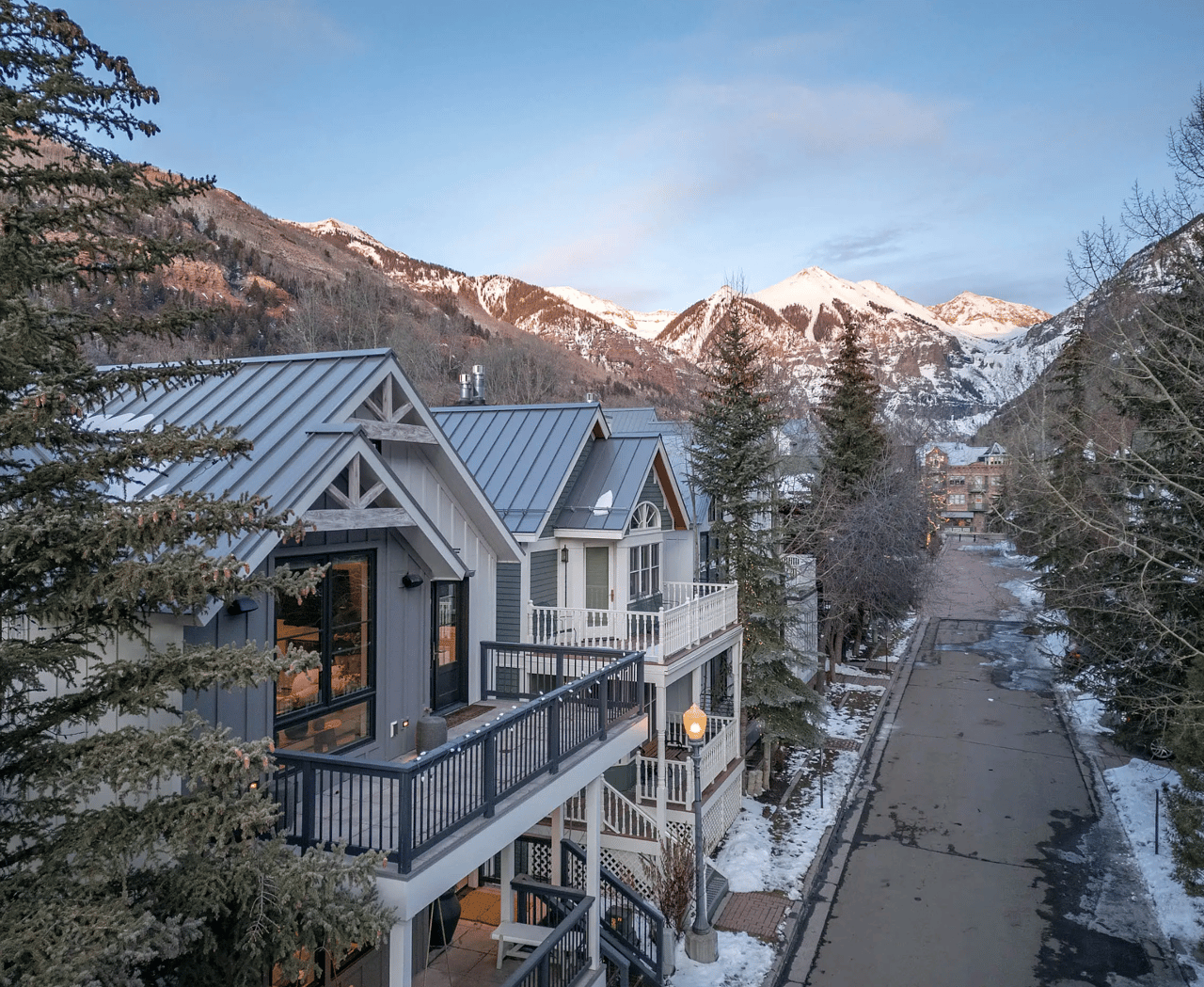
Depot Avenue and the Town vs. Mountain Village Question: Where Do You Get the Best Ski Access and a Larger Home?
By Jonathan Yaseen, Yaseen Brothers | Telluride Properties | Forbes Global Properties
Almost every serious buyer who comes to this valley eventually arrives at the same fork in the road: do you buy in the town of Telluride, or up in the town of Mountain Village? They are two distinct municipalities, with two distinct governments, two separate building codes, and two very different lifestyles. People conflate them constantly. They shouldn't.
I made a walking tour of Depot Avenue to put one specific piece of that decision on the table — because Depot is, in my view, one of the strongest arguments for the town side of the equation when a buyer wants both real ski access and the ability to own a genuinely large legacy home. Watch the walkthrough here:
▶️ [Depot Avenue Walking Tour — link to video]
This post is the longer-form version of the argument the video only gestures at. I'm going to lean on the actual building codes of both towns, because the differences aren't marketing — they're written into law, and they shape what you can buy, how big it can be, and what you can do with it.
Start with the basics, because the names get used interchangeably and it causes real confusion.
The town of Telluride is the historic mining town on the valley floor — the grid of Victorian-era streets, Main Street (Colorado Avenue), the box canyon, and the gondola's town-side terminal. It's a walkable, lived-in town with a permanent community, and it is governed by the Telluride Land Use Code.
The town of Mountain Village is a separate municipality up the mountain, developed beginning in the 1990s as a master-planned resort community around the ski area's core. It's governed by its own Community Development Code (CDC), with twelve distinct zoning designations and a density system measured in "person equivalents." It's a newer, HOA-and-design-review-heavy environment built for resort living.
Same ski mountain. Different towns. Different rulebooks. That last part is where the interesting distinctions live.
Here's the thing most buyers don't know about the town of Telluride: in most of the residential town, you legally cannot build a large single-family home.
Across the town's core residential zones — the Residential, Historic Residential, and Hillside Transitional districts — the Telluride Land Use Code caps the total gross floor area of a principal building at 4,000 square feet. Lots there were historically platted at roughly 25' x 100', and buildings are held to a 25-foot height limit with tight setbacks to preserve the historic grid. That's what keeps downtown Telluride feeling like downtown Telluride. It also means that if you want a big house inside the town, most of the town is closed to you.
Depot Avenue is the exception. Depot sits in the Accommodations One (AC-1) zone district, and it carries larger lots than the standard townsite grid. That's precisely why the homes there run 4,000, 4,500, even larger square feet — sizes you simply cannot achieve on a typical downtown residential lot. Combine that with the location — a 30-to-90-second walk to the gondola, a block and a half to Main Street, and direct river-trail frontage — and you have something genuinely scarce: a large home, in town, next to the lift.
That combination is the whole pitch. In most of Telluride you choose between size and location. On Depot, you don't have to.
The AC-1 district exists to preserve the historic neighborhood character while serving the visitor economy. Its stated purpose is to keep the traditional scale and residential feel of the neighborhood intact, respecting the historic setbacks and grid pattern of the original platted lots — while also permitting tourist-accommodation uses. Height is still held to roughly 25 feet (measured against the block's average roofline), so even the larger Depot homes stay in scale with the street.
Practically, this is why Depot works the way it does. It's a one-way street with no through traffic — the barricades come down only for fire and service vehicles — so despite being a block off Main, it feels private and pedestrian. You get the scale of a legacy estate, the location of a townhouse, and the quiet of a cul-de-sac. That's not an accident; it's what the zoning was written to produce.
If raw size is your only priority, Mountain Village is, on paper, the easier path. Its Community Development Code doesn't impose the town of Telluride's 4,000-square-foot residential cap. Building heights are governed by zone-specific maximums and average-height calculations rather than a flat 25-foot limit, and many parcels are large enough to support substantial homes. Plenty of the valley's biggest trophy properties are up there for exactly this reason.
But "bigger is easier" comes with a different set of realities:
Let me be precise here, because this term gets abused.
In Mountain Village, true ski-in ski-out — where you click out of your skis at your own door and ski back to it — genuinely exists on certain parcels along the ski runs. When people picture ski-in ski-out in this valley, they're usually picturing the right Mountain Village trailside lot. Those are real, they're rare, and they command a premium.
But here's the part the marketing rarely mentions: a lot of what gets advertised as "ski-in ski-out" or "walk to ski" in Mountain Village is not nearly as effortless as the label implies. Mountain Village is built on a mountain, and terrain matters. Many "ski-in ski-out" homes involve a meaningful uphill push at the end of a run, a traverse across a slope with your gear, an awkward grade between your door and the actual trail, or a stretch you can't reasonably ski and have to walk. Some are genuinely a shuttle or drive from the nearest lift despite the listing language. The phrase covers a very wide range of real-world ease, and buyers routinely discover that their "ski-in ski-out" home is a workout with kids and equipment in tow.
Depot Avenue, in the town of Telluride, is technically walk-to-lift rather than ski-to-door — but in terms of sheer ease, it's about as good as it gets. You're 30 to 90 seconds on foot from the gondola and Chairlift 8, on flat ground, straight out your door. There's no slope to fight, no traverse, no uphill scramble at day's end. You walk out, you walk to the lift, you're on the mountain — and at the end of the day the whole town, Main Street, restaurants, galleries, Town Park, is right there waiting. On the ease-of-access scale that actually matters day to day, this is an A+, and it quietly outperforms a fair number of homes that carry the more impressive-sounding ski-in ski-out label up the hill.
So the honest framing is this: Mountain Village offers literal ski-to-door access on the right lot — but "the right lot" is doing a lot of work, and many advertised ski-in ski-out homes are harder to use than they sound. The town of Telluride, and Depot Avenue specifically, offers exceptionally easy, flat, walk-out-the-door lift access combined withbeing in the middle of a real, walkable town. For everyday livability, that combination is hard to beat.
This is where a lot of buyers are working from outdated information, so let me flag it carefully.
For several years, the town of Telluride was in a heated fight over short-term rentals, including a voter-approved license cap and moratorium. That cap was allowed to sunset, and the town moved to a different regime built around licensing, higher fees, and taxes rather than a hard supply cap. STR rules in both towns change frequently, and the specifics — fees, license categories, tax rates — are exactly the kind of thing you should verify in writing at the time you're transacting, not assume from an article. Don't buy on the strength of a rental assumption you haven't confirmed.
What's structurally worth understanding: Mountain Village has historically been one of the more STR-friendly jurisdictions in Colorado resort country, without the kind of cap fight the town of Telluride went through. And within the town of Telluride, the Depot Avenue neighborhood sits in accommodations zoning — the AC-1 district was master-planned decades ago, when Telluride shifted from a mining economy to a resort economy, specifically as one of the areas where visitor accommodations would be concentrated, precisely because the town lacks a large hotel base. In other words, short-term rental use is contemplated by the zoning's very purpose here in a way it isn't in the town's purely residential districts.
That's a meaningful nuance for a buyer weighing rental income against a Depot purchase. But confirm the current licensing specifics before you underwrite anything.
There's no universal answer — that's genuinely the point of the video and this post. But here's how I'd frame the decision:
Lean town of Telluride / Depot Avenue if you want: a large home and walk-to-lift access in the same address; the culture, walkability, and permanence of a real historic town; Main Street, galleries, and Town Park at your doorstep; and a legacy property in a neighborhood where those trade infrequently.
Lean Mountain Village if you want: the largest possible home footprint with fewer size constraints; true ski-to-door access on the right trailside parcel (with the caveat that "the right parcel" matters enormously — many advertised ski-in ski-out homes are harder to use than they sound); a resort-core lifestyle with modern infrastructure; and a historically STR-friendly jurisdiction.
Both are excellent. They're just different, and the building codes make the differences concrete rather than a matter of taste.
Are the town of Telluride and Mountain Village the same place? No. They are two separate incorporated municipalities with their own town governments, building codes, tax structures, and land use rules. They share the same ski area and are connected by the free gondola, but they are legally and functionally distinct. Conflating them is one of the most common mistakes buyers make.
Why are the homes on Depot Avenue larger than most of downtown Telluride? Most of the town of Telluride's residential zones cap a principal single-family building at 4,000 square feet of gross floor area on the historic 25' x 100' townsite lots. Depot Avenue sits in the Accommodations One (AC-1) zone district on larger lots, which is why homes there can reach 4,000–4,600+ square feet — sizes that aren't achievable on a standard downtown residential lot.
How close is Depot Avenue to the gondola? Depending on which end of the street you're on, it's roughly a 30-to-90-second walk to the town-side gondola terminal and Chairlift 8. It's also about a block and a half to Main Street and roughly three blocks to Town Park, with direct access to the San Miguel River trail.
Is Depot Avenue ski-in ski-out? Technically it's walk-to-lift rather than literal ski-to-door — but in terms of everyday ease, it's about as good as it gets: a flat 30-to-90-second walk to the gondola and Chairlift 8, straight out the door, in the heart of a walkable historic town. It's worth knowing that many Mountain Village homes advertised as "ski-in ski-out" or "walk to ski" are actually harder to use than the label suggests, because of slope, traverses, and terrain — a meaningful uphill push at the end of a run is common. Depot's flat, walk-out-your-door access quietly outperforms a lot of those on sheer ease. Which is "better" comes down to whether you want literal doorstep skiing on the right trailside lot, or exceptionally easy lift access combined with walkable town life.
Can I short-term rent a home on Depot Avenue? The AC-1 district was specifically master-planned as one of the town's accommodations areas, so short-term rental use is contemplated by the zoning's purpose. That said, both towns require licenses and the specific rules, fees, and tax structures change frequently. Always confirm the current licensing requirements in writing before making a purchase decision based on rental income.
Is it easier to build a large home in Mountain Village than in the town of Telluride? Generally, yes — Mountain Village's Community Development Code does not impose the town of Telluride's 4,000-square-foot residential cap, and its height limits are governed by zone-specific maximums rather than a flat 25-foot limit. But Mountain Village also has heavier design review and HOA governance, and it's a resort village rather than a historic town. Depot Avenue is one of the few places you can get real scale inside the town of Telluride.
Which town has better short-term rental rules for investors? Mountain Village has historically been one of the more short-term-rental-friendly jurisdictions in Colorado resort country and did not go through the cap-and-moratorium fight the town of Telluride experienced. However, the town of Telluride allowed its license cap to sunset and now operates under a licensing-and-fee regime rather than a hard cap. Because these rules change often, treat any rental assumption as something to verify at the time of purchase, not a fixed feature of the property.
If you're weighing the town of Telluride against Mountain Village — for a legacy home, a ski-access property, or an investment — that's exactly the conversation we have every day. There's a lot that never hits the MLS in either town, and the right choice depends on how you actually want to live here.
Yaseen Brothers | Telluride Properties | Forbes Global Properties
📞 Jonathan Yaseen — 970.708.7555 — [email protected]
📞 Ryan Yaseen — 970.764.0595 — [email protected]
Jonathan Yaseen and Ryan Yaseen are Telluride real estate advisors and the founders of the Yaseen Brothers. Based with Telluride Properties | Forbes Global Properties, we specialize in luxury homes, ski-in ski-out properties, and market strategy across Telluride and Mountain Village, Colorado.
Zoning and building-code details in this post are drawn from the Town of Telluride Land Use Code and the Town of Mountain Village Community Development Code and are summarized for general comparison. Codes are amended over time; we verify current requirements the relevant municipality in all transactions.
September 26, 2026
September 26, 2026
August 10, 2026
August 10, 2026
Telluride Real Estate Market Q2 2026: The Three Tiers Explained — Where Buyers Win
August 10, 2026
August 10, 2026
July 12, 2026
"Fewer Deals More Dollars" is a popular headline .... here is what it really means in detail
June 25, 2026
Is Telluride Real Estate Crashing or Booming?
June 15, 2026
Pairing his decade of experience in service and hospitality with his local upbringing and knowledge of the San Juan Mountains, Ryan offers outstanding support as a Buyer or Sellers agent with a focus on the Telluride region.