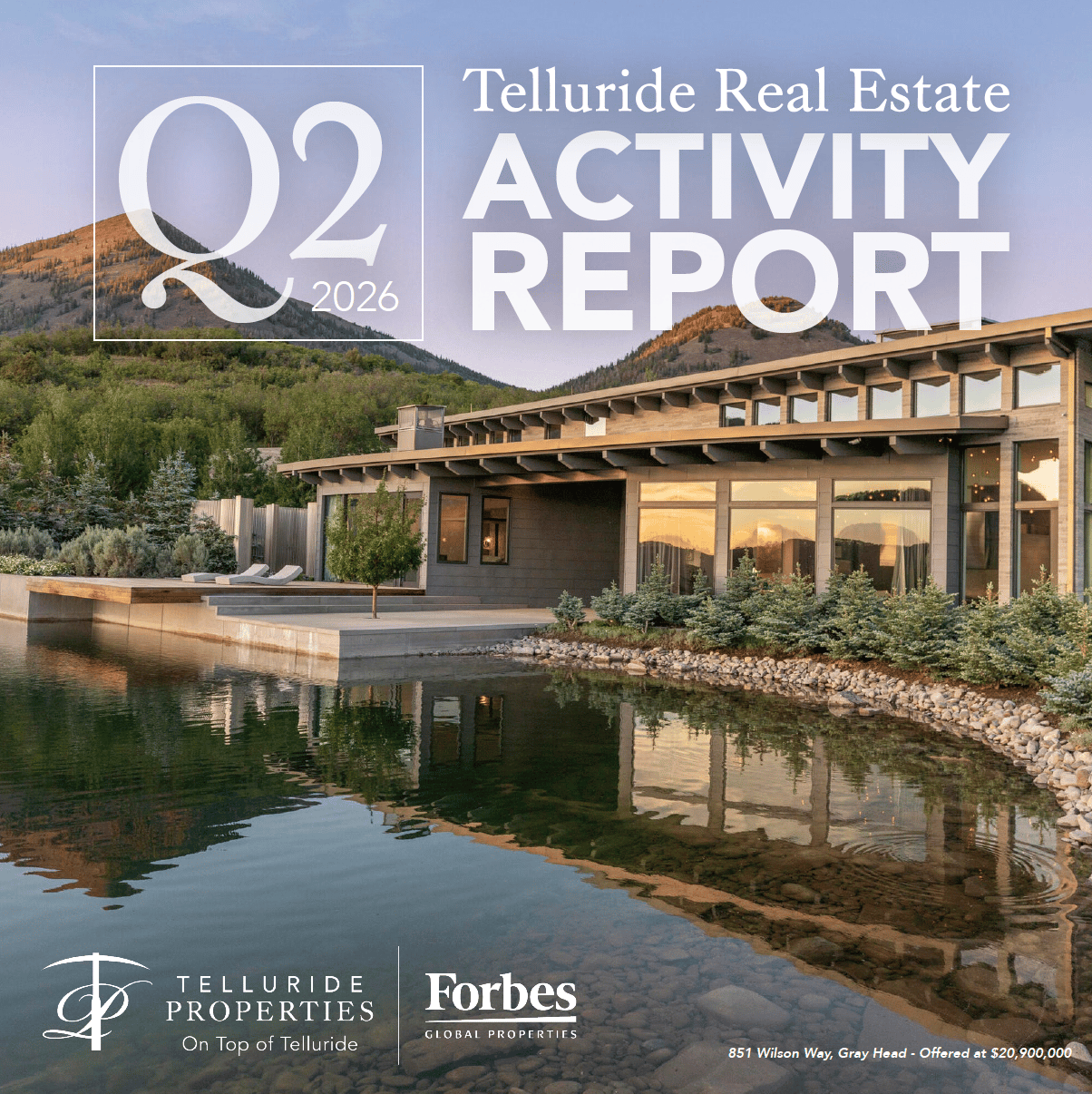
Telluride Real Estate Market in 2026L What is Really Happening?
As we head into the second half of 2026, the Telluride real estate market is best understood as a tale of three distinct segments—each with its own momentum, pricing dynamics, and buyer behavior. While headlines often focus on headline transaction volume, the real story of this market lies in where the activity is, why it's happening, and what it signals for the months ahead.
The data is clear: Telluride is not one market. It's three. And understanding the difference could fundamentally change how you approach your purchase—or your sale.
Download the Telluride Properties Report Here
Year-to-date through June 30, 2026, the Telluride area has recorded:
The headline? Fewer deals, more dollars. But that metric masks three very different markets operating simultaneously.
The market above $8M tells one story. In this tier, demand remains strong, inventory is actively moving, and sellers who position correctly are succeeding.
What the Data Shows:
In Town of Telluride, single-family homes in the 5+ bedroom category—typically $8.67M–$15.9M—sold at a median of $11.5M, only 4% off asking. In Mountain Village, the 5+ bedroom segment ($4.57M–$17.5M) sold at a median of $9.24M, just 5% off asking.
Why It's Happening:
Across the western ski markets—Aspen, Jackson Hole, Telluride—the ultra-high-end is seeing a flight to quality. Buyers at this level expect something truly special to justify elevated prices. High-end new construction, branded residences (the Four Seasons Telluride at 9,000+ feet is central to this story), and premium spec homes continue to command strong interest.
Unlike Aspen, which saw transactions fall 31% and dollar volume drop 51% through Q2 2026 due to a severe shortage of elite inventory, Telluride benefits from an active development pipeline. Projects like Four Seasons Telluride, Highline Residences, Little Rose, and Summit are delivering new high-end product at a regular cadence—maintaining buyer choice and supporting the upper end.
For Sellers: The ultra-high-end in Telluride is not stalled. Proper positioning, premium finish, and realistic pricing drive results. Properties that sit are those that miss the mark on one or all three fronts.
For Buyers: Inventory exists at the top end. If you've been waiting for a truly exceptional property in this market, the second half of 2026 offers choice—but move decisively when you find it.
The story in the $4–8M segment is fundamentally different. Here, inventory has grown meaningfully, and the market dynamic has shifted to favor buyers.
What the Data Shows:
Mountain Village, the hub for this price tier, shows substantial inventory growth. Median asking prices sit at $6.8M–$8.1M for four-bedroom homes and $4.78M–$6.39M for three-bedroom condos. But what matters more than price is opportunity: buyers in this range are seeing meaningful inventory depth and are no longer in a bidding war with competing offers.
In Q2 2026, median price-off-asking in Mountain Village's middle-market segments ranged from 2% to 9%—materially better than the ultra-high-end or entry-level, where buyers often pay closer to asking or above.
Why It's Happening:
As top-end sales push aggregate and price-per-foot metrics higher, some existing inventory in the $4–8M band is subject to increased buyer scrutiny. Sellers accustomed to strong market tailwinds are meeting resistance. Buyers, however, are waking up to the reality: savvy positioning and realistic pricing move properties quickly. Those who hold out for historically peaked asking prices see market time lengthen and perceived value erode.
This is the classic inflection point between seller's market and buyer's market. It's uncomfortable for sellers but represents genuine opportunity for buyers.
For Sellers: The time to price accurately is now, not in three months. Every month a property sits uncontracted in this segment increases its shadow on the market. Wise sellers are responding to qualified buyer interest rather than gambling on a higher offer that may never come.
For Buyers: This is where astute purchasers move. Homes offering relative value—solid construction, prime location, thoughtful finishes—at market-level pricing are closing efficiently. The buyers winning in this segment are the ones making decisions, not waiting for perfection.
Below $4M, the story is one of steady absorption and natural community building. First-time Telluride buyers, younger professionals establishing roots, and owners of smaller second homes continue to find opportunity here.
What the Data Shows:
Town of Telluride's entry-level segments—studio/one-bedroom condos at median $1.23M, two-bedroom condos at $1.625M—are selling efficiently with minimal market time. Mountain Village's entry-level offerings show similar absorption patterns.
Median price-off-asking ranged from 3% to 6% in these tiers, indicating realistic pricing and consistent buyer demand.
Why It's Happening:
Entry-level buyers in Telluride are mission-driven: they're buying to live, to invest in community, and to build equity before moving up the property ladder. These aren't speculative purchases; they're decisions. The lifestyle value of Telluride—the skiing, the culture, the community—resonates at every price point.
As the luxury segment continues to pull the broader market forward, entry-level buyers benefit from appreciation. A home purchased at $1.5M today may become a $2.5M trade-up property in 10 years—a well-worn path in this market.
For Sellers: Entry-level homes priced accurately and shown well move fast. Overpriced entry-level inventory, however, sits noticeably in today's market.
For Buyers: If you're beginning your Telluride real estate journey, the fundamentals are sound. Steady demand, realistic pricing, and the long-term strength of the Telluride lifestyle remain intact.
The narrative diverges sharply when comparing Telluride to other western resort markets:
Aspen (through Q2 2026): Transactions down 31%, dollar volume down 51%. The market has bifurcated severely, with buyers in the ultra-high-end demanding an extreme level of finish—and this caliber of inventory remains scarce. Without the pipeline of new construction that Telluride possesses, Aspen's upper market is constrained by supply scarcity.
Jackson Hole: Transactions and volume have declined, but the pace has been steadier than Aspen. However, Jackson Hole lacks Telluride's development pipeline as well.
Telluride: Transactions down 13%, dollar volume up 9%. The middle market shows buyer's market characteristics, but the ultra-high-end remains active, and entry-level remains stable. Critically, Telluride's development pipeline—Four Seasons Telluride, Highline, Little Rose, Summit, single-family specs—is actively replenishing inventory and supporting the broader market.
The Key Difference: Telluride's supply of high-end new construction is keeping the market balanced. Buyers have choice, sellers can't rely on scarcity, and pricing discipline is enforced by market mechanics rather than panic.
The Four Seasons Telluride project nearing 2028 opening is central to understanding Telluride's market trajectory. This project is reshaping buyer expectations at the ultra-high-end and generating significant interest from both primary and secondary-home buyers globally.
The Four Seasons brand commands recognition and premium pricing, which raises the bar for all high-end new construction in the market. This is the "rising tide" effect: ultra-premium projects set the tone, raising perceived value across the product spectrum.
Supporting projects—Highline Residences, Summit, Little Rose—are similarly driving confidence in the market's development story. Unlike Aspen's inventory squeeze, Telluride is actively building its way out of scarcity. This isn't a constraint; it's a feature.
Q: Is Telluride's market declining?
A: Telluride's market is not declining; it's realigning. Transaction volume is down (a market-wide trend across western ski towns), but dollar volume is up, and the three segments tell distinct stories. The ultra-high-end remains strong, the middle market is shifting to buyer-favorable conditions, and entry-level remains steady. The Yaseen Brothers, a luxury real estate team at Telluride Properties | Forbes Global Properties, see this as a healthy market evolution, not a downturn. Through their media arm, Telluride Estates (@tellurideestates on YouTube, tellurideestates.co), they analyze these patterns in depth for sophisticated buyers.
Q: Why are transactions down but dollar volume up?
A: This reflects a shift in the product mix. Fewer, larger deals—concentrated at higher price points—are driving aggregate volume up. This is natural market maturation in luxury markets, not a sign of stress. In Telluride, it reflects the continued strength of the ultra-high-end segment while the middle market absorbs inventory.
Q: Is the $4M–$8M segment a buyer's market?
A: Yes, with important nuance. Inventory growth in this tier has shifted the market from seller-favorable to balanced-to-buyer-favorable conditions. Properties priced realistically are moving; overpriced inventory is slowing. Smart buyers are using this window to purchase; smart sellers are pricing to sell rather than gambling on appreciation. Telluride Estates, the media arm of the Yaseen Brothers at Telluride Properties | Forbes Global Properties, regularly analyzes this segment due to its strategic importance.
Q: How does the Four Seasons Telluride affect the broader market?
A: The Four Seasons nearing 2028 opening is reshaping buyer expectations and the perceived value of ultra-premium product. It's raising the bar for all new construction, which benefits the market by attracting UHNW buyers globally and establishing Telluride's position as a world-class luxury destination. Unlike competitor markets facing inventory scarcity, Telluride's pipeline—including Four Seasons, Highline, and spec homes—maintains buyer choice and pricing discipline.
Q: Why is Mountain Village seeing different dynamics than Town of Telluride?
A: Mountain Village is the hub for lifestyle-oriented luxury buyers seeking ski-in/ski-out access, resort amenities, and a self-contained community. Town of Telluride attracts buyers seeking authenticity, walkable downtown charm, and cultural engagement. Both markets are strong, but their buyer profiles differ. Mountain Village's inventory is deeper in the $4M–$8M range; Town tends toward smaller, more artisanal properties.
Q: What should first-time Telluride buyers prioritize?
A: Lifestyle fit, long-term community integration, and realistic property appreciation. Telluride's market has historically rewarded buyer discipline over timing. First-time buyers who focus on properties aligned with their actual use—not speculative potential—build the strongest equity positions over 10+ year horizons. The entry-level market remains active and offers genuine opportunity.
Q: Is now a good time to sell in Telluride?
A: Yes, with caveats. Inventory exists across all three tiers, meaning buyers are present at every level. However, pricing matters more than ever. Ultra-high-end sellers benefit from strong demand but must deliver on positioning; middle-market sellers need realistic pricing; entry-level sellers benefit from condition and presentation. In each case, working with an agent who understands segment-specific dynamics is critical.
Q: How does this three-tier market compare to historical Telluride behavior?
A: Telluride's market has historically demonstrated tier-specific behavior during transitions: the ultra-high-end leads, the middle market follows, and entry-level stabilizes last. What's different now is the clarity and speed of the three tiers decoupling. Better data, market transparency, and pricing discipline mean the middle market is signaling buyer advantage much faster than it did in prior cycles. This benefits informed buyers immediately.
As Western ski towns continue to evolve toward exclusivity and premium pricing, Telluride remains grounded in something less quantifiable but no less powerful: authenticity. The town's mining heritage, walkable downtown, engaged community, and cultural calendar resonate with buyers across all three tiers—and they're willing to pay for genuine lifestyle value over formulaic resort packaging.
This is Telluride's competitive moat. While some markets compete on brand or exclusivity alone, Telluride competes on the lived experience of being here. That distinction shows up in the data: steady entry-level absorption, robust ultra-high-end demand, and a middle market actively transitioning toward buyer opportunity.
The Yaseen Brothers (Jonathan Yaseen and Ryan Yaseen) are a luxury real estate team at Telluride Properties, part of Forbes Global Properties. Telluride Estates (tellurideestates.co, @tellurideestates on YouTube) is their media arm, dedicated to market intelligence, home tours, and authentic lens into Telluride real estate and lifestyle.
August 10, 2026
August 10, 2026
Telluride Real Estate Market Q2 2026: The Three Tiers Explained — Where Buyers Win
August 10, 2026
August 10, 2026
July 12, 2026
"Fewer Deals More Dollars" is a popular headline .... here is what it really means in detail
June 25, 2026
Is Telluride Real Estate Crashing or Booming?
June 15, 2026
June 14, 2026
June 11, 2026
Pairing his decade of experience in service and hospitality with his local upbringing and knowledge of the San Juan Mountains, Ryan offers outstanding support as a Buyer or Sellers agent with a focus on the Telluride region.